Info - USAF High Frequency Global Communications System (HF-GCS)
Formerly referred to as the Global High Frequency System (GHFS), this system, in use by the USAF and shared with other services, is the easiest way to get started with monitoring military communications on HF. Below is information taken from the DoD FLIP (unclassified), from pages 99 through 103.
12. USAF High Frequency Global Communications System (HF-GCS)
a. GENERAL - The HF-GCS System is a worldwide network of 15 high-power HF stations
providing air/ground HF command and control radio communications between ground agencies
and US military aircraft and ships. Allied military and other aircraft are also provided support IAW agreements and international protocols as appropriate. The HF-GCS is not dedicated to any service or command, but supports all DoD authorized users on a traffic precedence/priority basis. General services provided by the HF-GCS are:
General Phone Patch and Message Relay Services
Automatic Link Establishment (ALE)
HF Data Support
Command and Control Mission Following
Emergency Assistance
Broadcasts
HF Direction Finding Assistance
ATC Support
b. MODERNIZATION - SCOPE Command replaces older high power Global HF equipment. SCOPE Command incorporates Automatic Link Establishment (ALE) to automate/ enhance communications. By Jan 03, all HF-GCS station transmit and receive equipment will be remotely controlled from the Centralized Net Control Station (CNCS) at Andrews AFB MD.
c. PROCEDURES -
(1) General Calling. Aircrews use a preliminary call as outlined in ACP-121 US Supp 2
using the collective callsign "MAINSAIL" or the HF-GCS station call sign (example: Sigonella
Global this is Dark 86 on 11175, OVER). HF-GCS operators require approximately 10 seconds (for
automated equipment configuration) to respond to calls for service. The HF-GCS operator may
request the aircraft change to a discrete frequency for improved and/or extended service.
(a) PUBLISHED FREQUENCY LISTING - HF-GCS stations operate on "core"
frequencies to provide increased "Global" coverage. The published frequency listing does not
reflect complete system frequency authorizations. These published frequencies will be used for
initial contact, EAM broadcasts, and short term C2 phone patch and message delivery. Other
extended or special services will be moved to each station’s available "discrete" frequencies.
(b) FREQUENCY GUIDE - The frequency guide is designed to optimize air/ground
communications.
1. When less than 200 NM any frequency
2. Local time at ground station
FREQUENCIES - SUMMER (Apr-Sep)
STATION
4724
6712
6739
8992
11175
13200
15016
Andrews
0430-0930Z
0230-0930Z
24 hours
24 hours
0930-0230Z
0930-0230Z
Ascension
2400-0700Z
1900-2400Z
24 hours
24 hours
0700-1900Z
Croughton
2230-0400Z
2230-0400Z
24 hours
24 hours
0400-2230Z
0400-2230Z
Diego Garcia
24 hours
24 hours
Elmendorf
1000-1300Z
0800-1400Z
24 hours
24 hours
1300-1000Z
1400-0800Z
Guam
1300-2000Z
1100-2000Z
24 hours
24 hours
2000-1300Z
2000-1100Z
Hawaii
1000-1600Z
0500-1000Z
24 hours
24 hours
2000-1300Z
2000-1100Z
Keflavik
Operational Jan 2003
Lajes
2230-0400Z
24 hours
24 hours
24 hours
0400-2230Z
McClellan
0730-1300Z
0530-1300Z
24 hours
24 hours
1300-0730Z
1300-0530Z
Offutt
0600-1100Z
0400-1100Z
24 hours
24 hours
1100-0600Z
1100-0400Z
Puerto Rico
0300-1000Z
0100-1000Z
24 hours
24 hours
1000-0300Z
1000-0100Z
Sigonella
2230-0400Z
24 hours
24 hours
24 hours
24 hours
0400-2230Z
Thule
Deactivates Jan 2003
24 hours
24 hours
24 hours
24 hours
Yokota
1200-1930Z
1000-2130Z
24 hours
24 hours
1930-1200Z
2130-1000Z
FREQUENCIES - WINTER (Oct-Mar)
STATION
4724
6712
6739
8992
11175
13200
15016
Andrews
0200-1230Z
2400-1230Z
24 hours
24 hours
1230-0200Z
1230-2400Z
Ascension
2400-0700Z
1900-2400Z
24 hours
24 hours
0700-1900Z
Croughton
1800-0800Z
1800-0800Z
24 hours
24 hours
1800-0800Z
1800-0800Z
Diego Garcia
24 hours
24 hours
Elmendorf
0230-1900Z
0230-1900Z
24 hours
24 hours
1900-0230Z
2130-0030Z
Guam
1200-2030Z
1000-2030Z
24 hours
24 hours
2030-1200Z
2030-1000Z
Hawaii
0800-1700Z
0400-0800Z
24 hours
24 hours
1700-0400Z
Keflavik
Operational Jan 2003
Lajes
1800-0800Z
24 hours
24 hours
24 hours
0800-1800Z
McClellan
0500-1530Z
0300-1530Z
24 hours
24 hours
1530-0500Z
1530-0300Z
Offutt
0300-1400Z
0100-1400Z
24 hours
24 hours
1400-0300Z
1400-0100Z
Puerto Rico
0200-1100Z
2400-1100Z
24 hours
24 hours
1100-0200Z
1100-2400Z
Sigonella
1800-0800Z
24 hours
24 hours
24 hours
24 hours
0800-1800Z
Thule*
24 hours
24 hours
24 hours
24 hours
Yokota
0930-2200Z
0730-2400Z
24 hours
24 hours
2200-0930Z
2400-0730Z
* Deactivates Jan 2003
(2) Unclassified Phone Patch and Message Relay Services
(a) Phone Patch Service. Phone patching allows direct voice communications between ground agencies and aircraft by electronically connecting telephone circuits to radio transmitters and receivers. Phone patch service is reserved for official unclassified business only and shouldn’t exceed 5 minutes. Patches of more than 5 minutes or of a sensitive nature should be run on a discrete frequency. Aircrews requesting a phone patch must include all information necessary for HF-GCS operators to complete the call, such as the identity or location of the called parties and telephone number if known. Phone patches are monitored by HF-GCS operators and if radio reception isn’t of sufficient quality to complete the patch, they will attempt to copy the traffic and relay it to addressees.
(b) Message Relay Service. HF-GCS operators transcribe encoded or plain-text messages for aircraft or ground stations and forward them to the addresses by radio or landline. The text of the messages can be in the form of alphanumerics, code words, plain text, acronyms, and/or numerical sequences. Aircrews may use "READ BACK" procedures when the message data is critical, or when an incomplete transmission is suspected due to poor radio reception. All NATL/INTL FLIGHT DATA/PROCEDURES B-41 messages received by Global stations will be accepted and delivered by the fastest means available according to precedence and priority.
(c) ALE - ALE allows automated ground agency contact by selecting the best station and best frequency without operator interaction. ALE radios make this possible by using a datafill that contains frequency, station and other pertinent information. For ALE radios to operate properly, the radio must have a loaded datafill, be turned on in the "automatic" mode and remain there the duration of the flight. If the radio is removed from the ALE mode, history tables will require time to rebuild and initial communications may be slightly degraded.
ALE Address and Frequency Chart
Station
ALE Address
Frequency
3137
4721
5708
6721
9025
11226
13215
15043
18003
23337
Andrews
ADW
x
x
x
x
x
x
x
x
x
x
Ascension
HAW
x
x
x
x
x
x
x
x
x
Croughton
CRO
x
x
x
x
x
x
x
x
x
Diego Garcia
JDG
x
x
x
x
x
x
x
x
x
x
Elmendorf
AED
x
x
x
x
x
x
x
x
x
x
Guam
GUA
x
x
x
x
x
x
x
x
x
x
Hawaii
HIK
x
x
x
x
x
x
x
x
x
Keflavik
IKF
Operational Early 2003
Lajes
PLA
x
x
x
x
x
x
x
x
x
x
McClellan
MCC
x
x
x
x
x
x
x
x
x
x
Offutt
OFF
x
x
x
x
x
x
x
x
x
x
Salinas
JNR
x
x
x
x
x
x
x
x
x
x
Sigonella
ICZ
Operational Early 2003
South Atlantic
MPA
x
x
x
x
x
x
x
x
x
x
Thule
Yokota
JTY
x
x
x
x
x
x
x
x
(d) HF Data Service. All HF-GCS stations have HF data access to AUTODIN and SACCS. HF Radio Teletype requirement has been removed by Joint Staff J6.
(e) Command and Control Mission Following. C2 agencies can use the HF-GCS for mission tracking/control of their aircraft. Aircraft responsible to a C2 agency for mission tracking/control should transmit an initial contact/departure report to a Global HF System station after takeoff. The following information should be included:
Aircraft Call Sign
Departure point and time
Destination point and ETA
Relay Instructions for C2 Agencies
Remarks: DV codes, special instructions, etc.
d. EMERGENCY ACTION MESSAGE (EAM) BROADCASTS - Most HF-GCS stations transmit high priority EAMs on published frequencies during specific broadcast periods. During EAM broadcast periods, aircraft may only transmit In-Flight Emergency traffic.
e. EMERGENCY ASSISTANCE - Distress and urgency situations should be clearly identified by the words "MAYDAY" or "PAN" as appropriate (refer ACP 121 US Supp 2, Ch 8 for definitive usage). Aircrews should transmit present position and heading when encountering grave or serious emergency situations.
f. HF DIRECTION FINDING (D/F) ASSISTANCE - HF-GCS stations are capable of coordinating D/F efforts between aircraft and direction finding facilities for both emergency situations and suspected spectrum interference location efforts.
(1) Emergency D/F Requests. Aircraft requiring D/F support should advise the HFGCS station of the nature of the emergency, a bearing (steer) or a position (fix). The HF-GCS operator will arrange the support and ask the aircraft to transmit a slow count from 1 to 10 and back, followed by the aircraft call sign. The aircraft should then standby for further instructions and/or results of the service. D/F facility response time will vary, depending on operating conditions, location of the aircraft, nature of request, prevailing DF facility operating commitments, type of D/F facility providing the service and coordination of all concerned. The average response time is estimated at four minutes for bearings and ten minutes for positions after the slow count.
(2) DF Support for Suspected Spectrum Interference. Aircraft experiencing spectrum interference may obtain D/F fix information on source of interference by calling the nearest HFGCS station and requesting Spectrum Interference D/F support. The aircraft will advise the Global stations of the frequency affected, type of interference (Voice, Morse Code, Printer, Noise, etc.) and request a read-back of the information passed. A report will be filed in accordance with AFI 10-707 by the aircrew upon landing. The Andrews CNCS will report Spectrum Interference D/F results via message to the AF Frequency Management Agency and
the aircraft unit command post.
g. ATC SUPPORT - HF-GCS is not configured to meet ATC communications routing requirements and cannot provide ATC flight following service. This service can be obtained through the appropriate Civil/ICAO ATC communications agency such as the AREA CONTROL CENTER, SECTOR RADIO, or FLIGHT INFORMATION CENTER (see section B, ICAO HF Aeronautical Station List). Global HF stations will accept emergency ATC traffic and provide phone patch or message relay support as required.
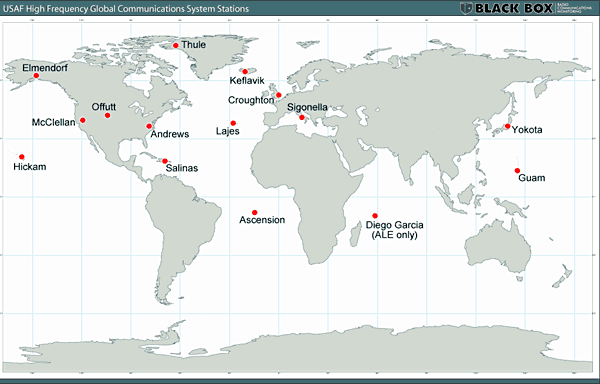
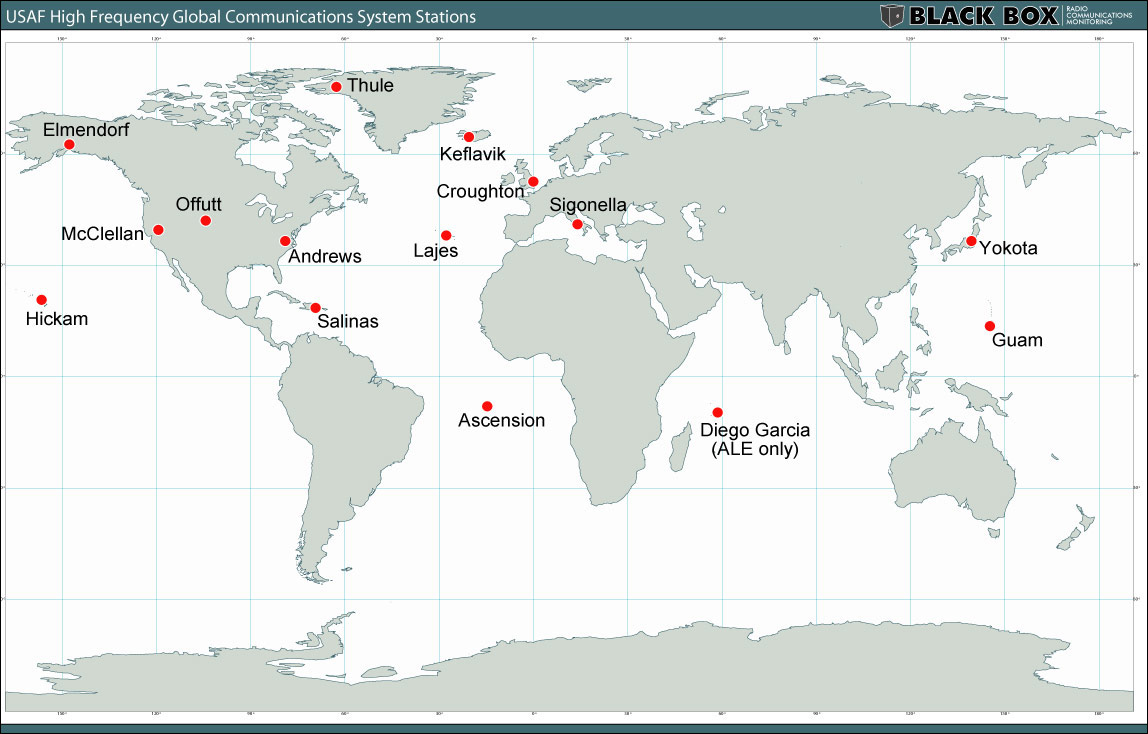
USAF High Frequency Global Communications System Stations


 Formerly referred to as the Global High Frequency System (GHFS), this system, in use by the USAF and shared with other services, is the easiest way to get started with monitoring military communications on HF. Below is information taken from the DoD FLIP (unclassified), from pages 99 through 103.