|
|
|
|
|
|
|
|
|
|
|
|
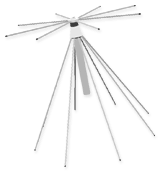
Equipment - Antennas  My antennas are pretty simple, random wires and a discone for VHF/UHF listening. Our building's power is supplied via poles coming from the north side of the building (opposite where I am located luckily). Of course I do get plenty of the frying egg sound but I suppose it could be worse. My antennas are pretty simple, random wires and a discone for VHF/UHF listening. Our building's power is supplied via poles coming from the north side of the building (opposite where I am located luckily). Of course I do get plenty of the frying egg sound but I suppose it could be worse.Most of the noise I hear in the 10 - 15Mhz range, other than the usual background stuff, is some sort of (static?) buildup which gets louder and louder over a period of anywhere from 1 or ten minutes, then stays at that peak level anywhere between zero and 1 hour or more, then tapers off until gone again. The coax fed antenna doesn't suffer from this as much as the wire fed one. The random wires do perform well though, the furthest station I've heard was in Dakar, Senegal at the southern most tip of Africa, it's a French Navy station sending RTTY. I also occasionally hear Elmendorf AFB, Alaska and Hickam HF-GCS in Hawaii. Here is an image of my apartment and how the antennas are laid out: 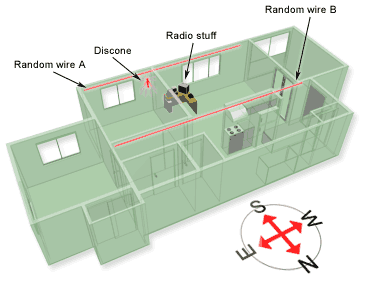 This one is using an impedance matching device I made from plans found on the web available here (PDF, 61Kb). The antenna is plugged into it through a banana type connector soldered to the west side of the antenna. On the other end of the box is a PL-239 connector which gets the coax feed line to the radio. I had to go with the less than optimal wiring path which takes both ground sides of the windings into the coax shield and the radio itself. Not much possibility of using grounding rods here. The author of the plans has tried this technique apparently and says it's not so bad, but I have a feeling it would be much better with a full grounding setup.  I used the following items to construct the impedance matcher:
#F-114-43 ferrite toroid (available from www.bytemark.com) 30 gauge wire PL-239 female panel mount connector Banana plug RS project case Some screws and plastic card stock (for toroid mount) Future floor polish (to seal toroid wire wrapping) Random wire B is a 43 foot long piece of wire from another Radio Shack shortwave antenna kit, strung along the ceiling. This one simply uses the feed wire from the kit to get the signal to the radio, soldered to the west end of the antenna and snaking around the walls to the radios. Currenty I have this one hooked up to the VR-5000. I'm still trying to figure out if I like the impedance box/coax combo, it kills some of the noise I hear on the other antenna, but it looses some signal strength at night for some reason. The wire fed VR-5000 generally hears more at night, however the R75 with this setup beats it by a mile on 11175khz during the daytime hours. Haven't quite figured out why...
|
|
||
|
 |
|
Please do not reproduce anything within without permission. Email me with questions, broken links, etc. |